Texas’ Economic Ascent
Houston, We Have Prosperity

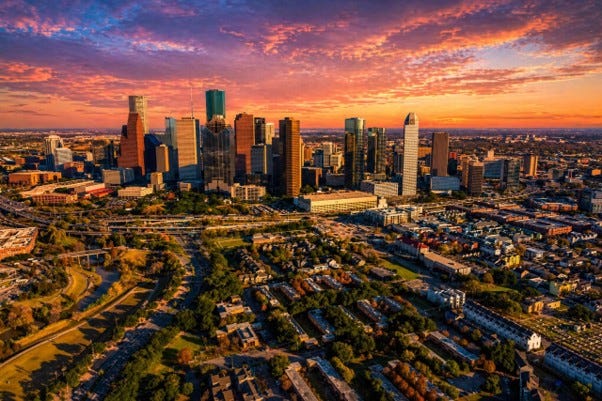
Houston, Texas.
The Houston air is humid. The streets are clean. From the 50th floor of a skyrise, an orderly park runs far into the distance, flanked by busy motorways and tall buildings seemingly of every industry under the low-lying sun.
The opportunities here are obvious. One senses the economic dynamism of the city and state more broadly, generally agreed to be performing better than many of its peers in the present.
Niall Ferguson states that the US’ federalised system of 50 states represents 50 live economic experiments playing out in real time. It is obvious to most ordinary people which states are performing well and which are lagging.
This column does not seek to make a thorough thesis other than an interlude of recognition of the state’s success.
The formula seems to be diverse industries, abundant land, low taxes and streamlined planning, quite straightforward one might think. But in the face of other US states which have blatantly over-regulated, it is worthy of attention.
Where the US’ leading companies choose to locate is where frontier technologies will be developed.
Statistics
The state has a population of around 32m, equivalent to Saudi Arabia, Mozambique or Madagascar.
It has over 1,700 cities, including Houston, San Antonio, Dallas, Austin and Fort Worth, relatively well spread out across the state.
It has a land mass the same size as France.
• Power, energy, oil, proximity to the sea, ports and increasingly data centers. Texas sits at the intersection of old and new industry. Oil and gas wealth laid much of the foundation, but the infrastructure, engineering expertise and capital pools are now feeding into newer sectors such as AI infrastructure, semiconductors and battery storage.
• An enormous amount of land that can still be developed. This sounds mundane but matters enormously. Housing, logistics parks, factories and data centers can still physically expand outward without the same constraints faced by many coastal cities elsewhere in the West.
• More relaxed planning laws. Development appears simply easier. Housing can be built faster. Warehouses emerge quickly. Roads expand. The cumulative effect over decades is lower costs and less friction across the economy.
• No state level income tax. For skilled workers, entrepreneurs and executives, this is a major pull factor. In a world where remote work and business mobility have increased, state competition matters more than before.
• No corporate income tax at the state level. Combined with relatively lower regulation, Texas has become increasingly attractive for firms looking to scale operations or relocate headquarters.
• Texas’ GDP now exceeds that of countries such as Italy, Russia, Australia, Canada. Income per head has continued to rise over time, whilst the state has also absorbed millions of new residents. Managing both growth and scale simultaneously is not straightforward.
Texas Incoming
The dumping of skills and capital into the state from others has been enormous.
Famously, Tesla moved its corporate headquarters from Palo Alto, California, to Austin, in 2021. In early 2024, Tesla shareholders also voted to officially move the company’s state of incorporation from Delaware to Texas. In 2024, Elon Musk announced he was shifting the SpaceX corporate headquarters from Hawthorne, California, to Starbase, Texas, following policy disagreements with the California state government.
Oracle, Hewlett Packard Enterprise and a range of technology and financial firms have also shifted significant operations into the state in recent years.
One can pick holes in arguments until the sun sets in the harsh west Texas desert. Questions around urban sprawl, inequality and infrastructure pressures are legitimate.
But for now, it pays to recognise that the devolution of economic policy allows for us all to keep moving forward.